 Georgian Baked Goods
Georgian food, explained
Khinkali: Georgia's soup dumplings, and how to eat them
From the mountains to every table
Khinkali come from the highlands of eastern Georgia: Pshavi, Khevsureti, Tusheti and Mtiuleti, where shepherding families needed food that was cheap, hot and filling. Over time they came down into the valleys and the cities, and today you will find them in every Georgian town, often ordered by the dozen and counted at the end of the meal.
Mountain style and city style
Mtiuluri (mountain) khinkali keep it simple: meat, onion, salt and pepper, sometimes with caraway. Kalakuri (city) khinkali add fresh herbs, especially coriander, for a greener, brighter filling. Both are made with a mix of beef and pork in most kitchens, and both depend on enough fat and water in the filling to make the broth.
The pleats
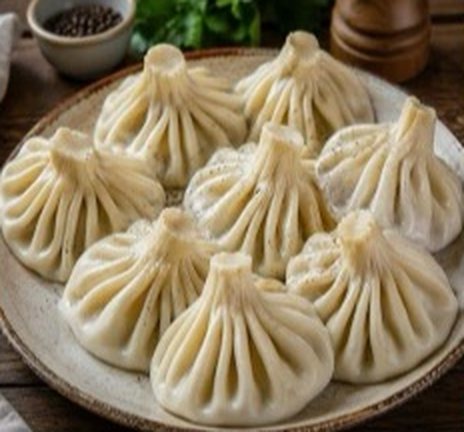
Every khinkali is folded by hand into a ring of pleats that gather at the top into a knot, called the kudi (hat). The pleats seal in the broth. Georgian cooks take pride in making many fine folds, and you will often hear that a well-made khinkali has at least 19.
How to eat khinkali
- Let them cool for a minute. The broth inside is very hot.
- Grind black pepper over the top, the traditional seasoning.
- Pick one up by the knot and turn it upside down.
- Bite a small hole in the side and sip the broth.
- Eat the rest, and leave the knot on your plate. Most people don't eat it, and the pile of knots is how the table keeps count.
Skip the knife and fork. Cutting a khinkali open spills the best part onto the plate.
Common questions
What is the difference between khinkali and other dumplings?
Khinkali are larger than most dumplings, have a twisted topknot instead of a sealed edge, hold broth inside, and are eaten by hand rather than with a fork or spoon.
Do you eat the top of khinkali?
Usually not. The knot is thick dough, so most people hold it as a handle and leave it on the plate.
How many khinkali should I order per person?
Appetites vary, but in Georgia five to ten per person is a common meal.
By the team at Georgian Baked Goods, a Georgian bakery at 10 Plastics Ave. in Etobicoke, Toronto. Updated .