 Georgian Baked Goods
Georgian food, explained
Khachapuri: a guide to Georgia's cheese breads, region by region
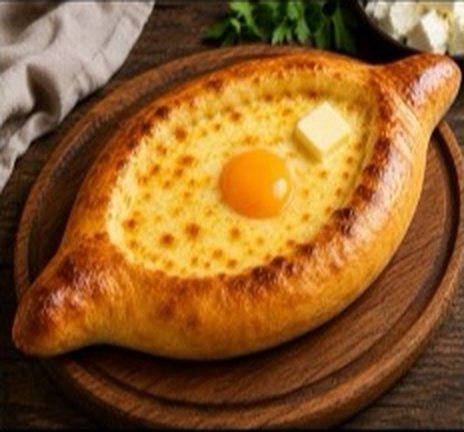
Ask a Georgian what to eat first and the answer is nearly always khachapuri. It is breakfast, lunch, the bread on the supper table and the thing you bring when you visit. It is so central that economists at Tbilisi's ISET Policy Institute track a Khachapuri Index, comparing the cost of baking one across Georgian cities the way others compare the price of a Big Mac. In 2019 Georgia added the tradition of making khachapuri to its list of intangible cultural heritage.
The cheese inside
Two Georgian cheeses do most of the work. Imeruli is a fresh, slightly sour curd cheese from the Imereti region. Sulguni is a brined, stretchy cheese from Samegrelo, in western Georgia, that melts into long strings. Most bakers blend them, and so do we: imeruli for tang, sulguni for the pull.
Imeruli khachapuri: the everyday one
From Imereti, in west-central Georgia. A round, flat bread sealed all the way around its cheese, then baked until golden and cut into wedges like a pie. If you only try one kind, try this one: it is the khachapuri most Georgian families make at home.
Megruli khachapuri: twice the cheese
From Samegrelo (Mingrelia), the western lowlands near the Black Sea, which is also the home of sulguni. Megruli starts as an Imeruli, then gets a second layer of cheese baked on top. Richer and better for a crowd.
Adjaruli khachapuri: the boat
From Adjara, on the Black Sea coast around Batumi. The dough is shaped into an open boat, filled with cheese, baked, then finished with a raw egg yolk and a piece of butter. It is the khachapuri most people outside Georgia have seen on Instagram.
How to eat it: while it is hot, stir the yolk and butter into the molten cheese with a fork until glossy. Then tear off pieces of the crust from the ends and dip them into the middle. Work from the outside in.
Penovani khachapuri: the flaky one
Made with laminated, puff-style dough folded around cheese, so it bakes into crisp, buttery layers. Penovani is the grab-and-go khachapuri of Tbilisi bakeries and street kiosks, and it travels well.
Gurulo: the crescent from Guria
From Guria, a small region in western Georgia. Gurulo (also called Guruli khachapuri) is folded into a half-moon around cheese and boiled egg. In Guria it is traditionally baked for Christmas, which Georgia celebrates on January 7.
Mtiuluri khachapuri: from the mountains
Mtiuleti is a mountain region north of Tbilisi, along the Aragvi river valley and the old Georgian Military Road. Its khachapuri is a hearty, cheese-filled pie in keeping with highland cooking: simple, filling and made to keep you going.
Keeping and reheating khachapuri
Khachapuri is best warm, on the day it is baked. To bring one back, warm it in a 180 °C (350 °F) oven for 5 to 8 minutes, until the cheese softens. The microwave works in a hurry, but the crust goes soft. Adjaruli is the exception: eat it straight away.
Common questions
What is the difference between Imeruli and Megruli khachapuri?
They start the same way: a round bread sealed around cheese. Megruli adds a second layer of cheese baked on top, so it is richer and more golden.
Is khachapuri vegetarian?
The filling is cheese, with egg in Adjaruli and Gurulo; there is no meat in it. If you avoid animal rennet, ask us about the cheese before you order.
How do you eat Adjaruli khachapuri?
Stir the egg yolk and butter into the hot cheese, then tear pieces of crust from the ends and dip them into the middle.
How do you pronounce khachapuri?
Roughly khah-chah-POO-ree. The opening kh is a throaty sound, like the ch in Scottish loch.
By the team at Georgian Baked Goods, a Georgian bakery at 10 Plastics Ave. in Etobicoke, Toronto. Updated .